
Idaho Recent Arrests Start Locally
Idaho has no single statewide roster for new bookings. Each county builds its own arrest records. Each jail controls what the public can see. A booking may appear as a dated card, a current-custody row, or a daily PDF. Some arrests never reach a public web page at all. A current roster answers who is housed now, not the full story of the last day or a person's complete arrest history.
County habits show why one path never fits all. Ada County pairs a time-filtered arrest report with a separate inmate roster. Canyon County splits its Current Arrests booking view from a distinct Jail Roster product. Kootenai County's Daily Press Log runs on a 05:00 report boundary. Twin Falls posts a weekday Arrest/Release report that can fold in releases and sentenced entries beside bookings. Bonneville and Power counties show current custody, with no separate 24-hour archive. These are local patterns, not statewide rules.
Start with the arrest county's own source and read its window label. A missing row can mean several things. The page may not have refreshed. The person may have been released or transferred. Another agency may hold the event. Or the county may not publish one. A gap is not proof that no arrest happened. For same-day detail and fallback paths, see the Arrests Last 24 Hours page; multi-day reports and archives sit on the Police Blotter page.
Find Idaho Arrests by County
Start with the county where the arrest happened. A person's home county or court county can mislead. The Idaho County Directory routes you to each county's local arrest-record guide. That guide maps the sheriff's roster, city-police handoffs, local booking feeds, and the records custodian. City arrests add a wrinkle. A municipal department may make the arrest while the county jail holds the booking. So check both the arresting agency and the jail.
Some counties offer a clean online search. Others share a PDF, a public-safety app, or a bare current list with no arrest-time filter. Some rural counties have no stable public web roster. There, an official jail contact or the arresting agency's records desk is the practical route. VINE and a targeted public-records request also work. These gaps are part of the answer, not noise. They are no reason to swap in a third-party directory for the government record.
When the location is unclear, use a known city, the arresting agency, or the court county as a lead, then confirm the custodian. County seats in the directory are only routing labels. Arrests don't always happen there. A transfer can move someone to a neighboring county or a state facility, so read each source on its own location and custody terms.
Idaho Arrests Run on Three Clocks
Booking, custody, and court run on separate clocks. A booking record starts when the arrest is processed. A jail roster shows current housing. A court portal shows a filed case and its later events. Ada's selectors cover the last four hours, 24 hours, and five days. Kootenai's daily log keeps its 05:00-to-05:00 boundary. Twin Falls can combine booking and release entries. One name may show in a single source while the others stay blank, and no single page tells the whole story.
For a same-day check, use the local source's exact window and note the displayed time. Systems lag after booking, protected records stay hidden, and released names drop off the list. For custody status and release alerts on one person, use VINELink Custody Check. It is not an arrest-history search.
Fresh bookings take time to appear online. For urgent custody questions, call the responsible jail or arresting agency. Use the court record for a filed charge.
Where Idaho Arrests Appear
Match the channel to the question. County pages lead for booking records and current custody. Court, state, and federal tools cover other parts of the record trail. News feeds and commercial directories run secondary, often partial, delayed, or stale, and never replace the source agency.
| Source | What it can show | Limit to keep in mind |
|---|---|---|
| County sheriff or jail | Booking entries, current custody, local logs, and sometimes photos | Window, fields, and photo policy vary by county |
| Idaho State Police News Releases | Selected arrests, task-force results, DUI enforcement, and public-safety events | Narrative releases are not a full arrest roster |
| Idaho iCourt | Public case filings, hearings, docket entries, and dispositions | A filed case is not a live custody check |
| IDOC Resident/Client Search | State incarceration, probation, parole, and related status | It is updated daily and is not a fresh county booking feed; no public photo field was identified |
| VINE and VINELink | Reported custody changes and optional release or transfer alerts | It does not cover every custody system or provide a photo archive |
| News, RecentlyBooked, BustedNewspaper, Mugshots.com, Arrests.org | Selected articles or third-party county/state pages | Unofficial, incomplete, and subject to stale copies or errors |
The Idaho Police Blotter gathers the wider landscape of local logs and news examples. It also explains the difference between a live window and a saved archive. Idaho State Police points to Citizen Connect and an incident-data tool. Neither is an arrest roster. They show incidents and cases. For arrests, a county booking source at the jail still matters far more.
Third-party sites demand caution. RecentlyBooked says its Idaho directory covers a 30-day window. It does not include every county. BustedNewspaper carries an Idaho section with partial coverage. Mugshots.com and Arrests.org run state-branded pages too. Content shifts, counties go missing, and old data can linger after an official page updates. Mugshots.zone shows no Idaho section, so none is claimed here.
Some publishers offer a free way to report an error. That covers a wrong-person match, a sealed or expunged result, or a changed disposition. A correction request is not a government records request. Results are never promised. Check the county and court source first. Never pay anyone who promises to erase accurate public material. RecentlyBooked's published correction and removal policy sets out its own steps and fees. That policy page is text, not a photo gallery.
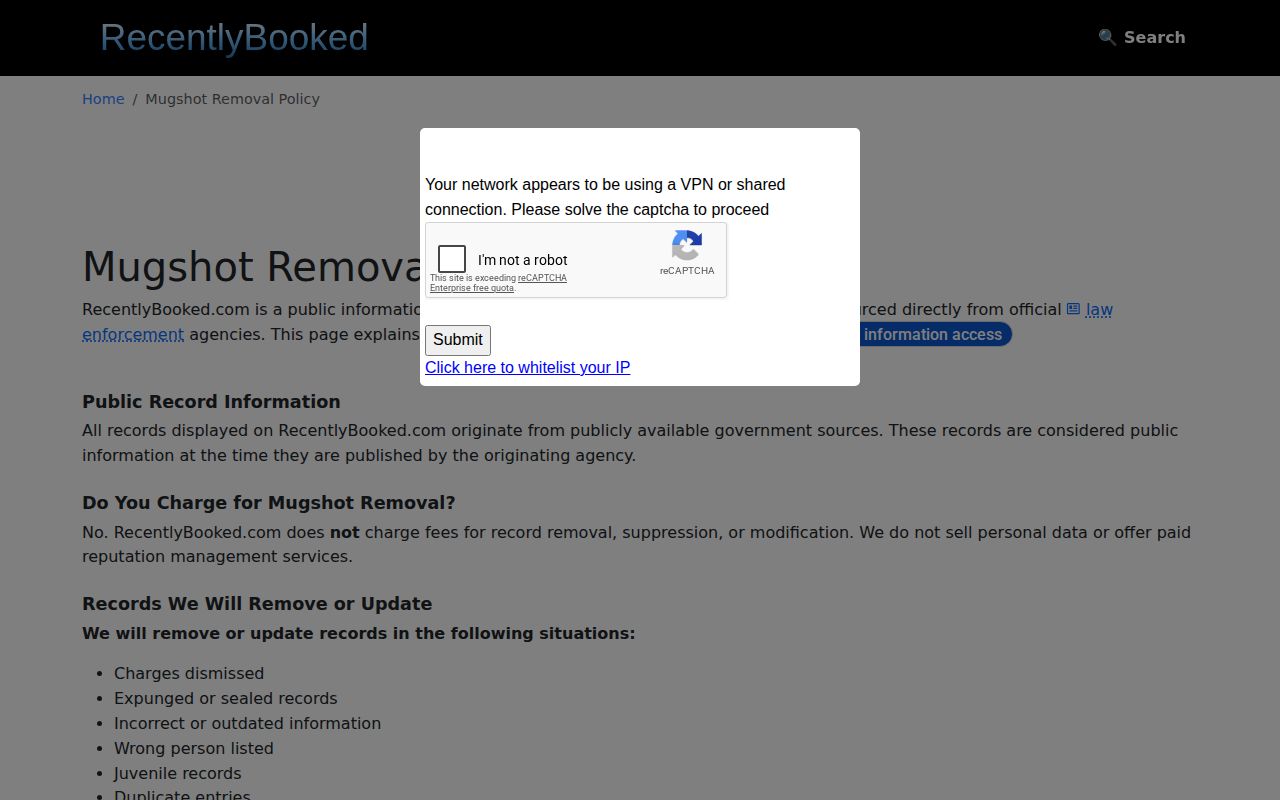
That policy belongs to a private publisher, not Idaho government. An official record or court order still controls what the state's own source holds.
Idaho Mugshots and Booking Photos
Idaho Code §20-601 covers booking at a county jail, including a photograph and fingerprints. Publishing the image online is another matter. The statute sets no posting rule and no required archive period. Practice varies by sheriff. One roster shows a booking photo. Another lists only a name and date. A third reveals a photo only after opening a booking detail. A blank screen never proves the custodian holds no image.
Ada and Canyon County booking views display photos. Bonneville's current inmate list shows an image too. Power County places its photo at the booking-detail level. Kootenai's daily log and Twin Falls' dated reports stay text-only. Each example describes one interface, not every record in that county. Juvenile and protected records follow separate rules. They must not be sought through an adult-style feed.
IDOC's Resident/Client Search tracks later custody and supervision. Its public result page shows no booking-photo field. A county booking photo, an IDOC record, and a news image are three different things. The direct photo question goes to the county jail or arresting agency that holds the booking file. The deeper rules sit on Arrest Record Laws. The official text of Idaho Code §20-601 explains the county-jail booking process and its photograph requirement.
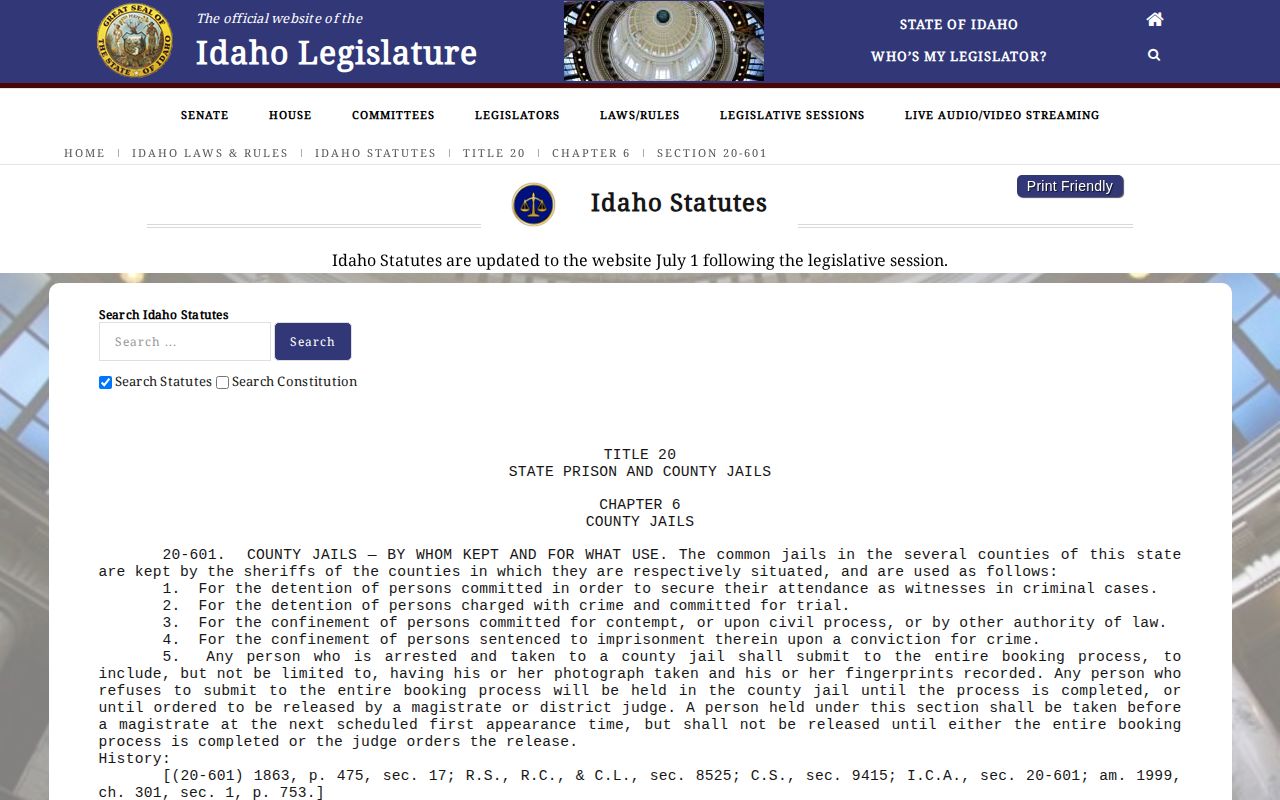
So the statute explains why a booking system may hold a photo. It sets no universal internet posting rule.
For later state custody, IDOC's public search is the official path. The page allows name or IDOC-number searches, updates daily, and shows status fields. It is not a county arrest feed. Its public view carries no offender-photo field.
A screenshot of the Idaho State Police website shows the agency's official identity and public routes. ISP does not run county jails. Its news releases are not a statewide mugshot database.

After an ISP arrest, the county jail normally holds the booking record and photo. That follows once the arresting jurisdiction picks a county custody destination.
Idaho Warrants and Fugitive Lists
Idaho has no single ISP "most wanted" roster covering every county warrant. The IDOC Fugitive Recovery page lists people sought in connection with state supervision. That list is narrow. Absence from it does not mean a person has no warrant. A listing does not mean the person sits in a county jail right now.
County sources answer narrower questions. Kootenai's In-Custody Report hub posts felony and misdemeanor wanted reports. These sit beside its inmate and press-log documents. Twin Falls keeps active-warrant material on its Warrants & Arrest Documents page. Elsewhere, sheriffs may publish a dated list. Some point to a records unit, and some offer nothing searchable. Always read the county label and report date first.
The ISP ILETS page describes a law-enforcement network. It ties into national wanted and missing-person files. The public cannot query it. Idaho iCourt can display a filed case or hearing. It is neither a live warrant database nor a custody roster. For a specific warrant, contact the issuing court or agency, or ask a lawyer. Do not use a public list to plan around law enforcement.
Never approach or try to detain anyone on a wanted list. Call 911 if danger is immediate; pass nonemergency tips through the agency or Crime Stoppers.
The Idaho iCourt portal opens the state court record search with its public-access notices.
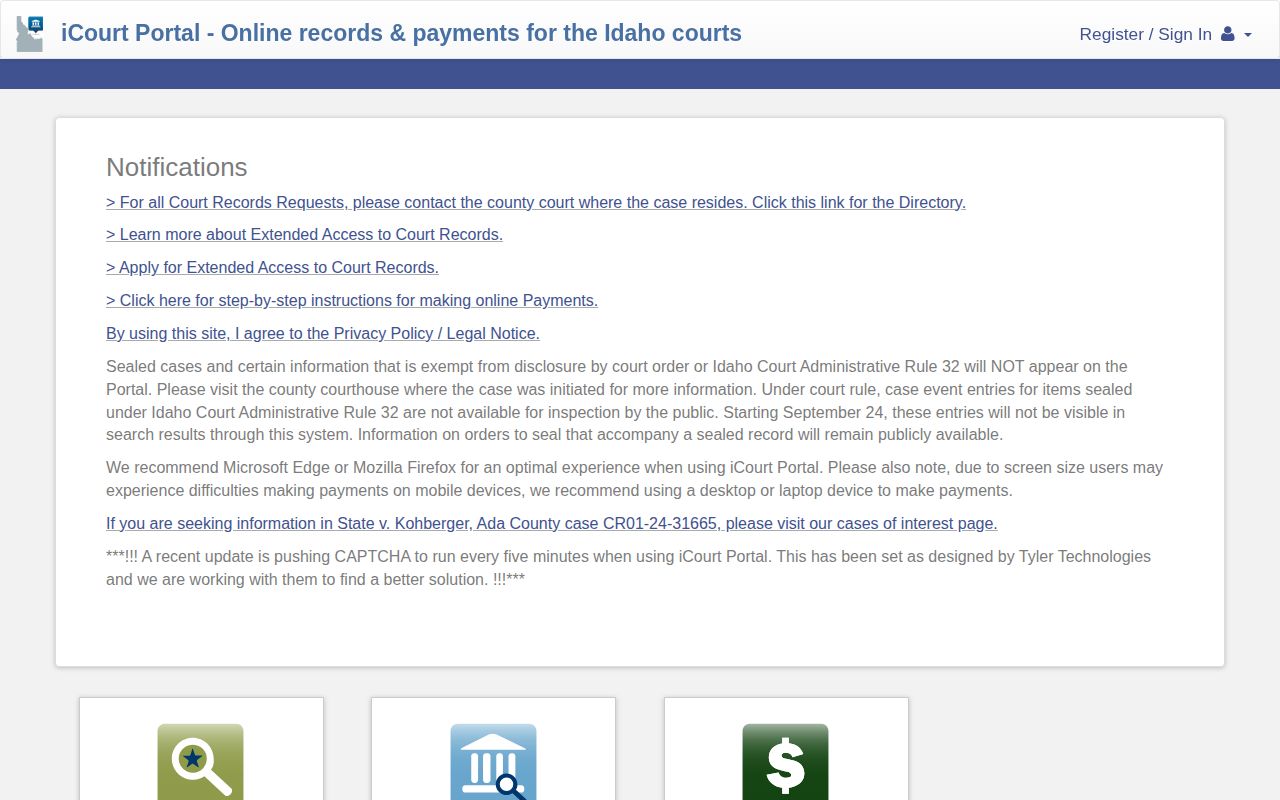
Follow a public case through the portal first, then check any warrant with the issuing court.
What Idaho Booking Records Show
A booking record documents the arrest event itself. It also tracks how the jail processed the person. Exact fields vary by system. Each agency decides what it may show. A public feed might list only a few details. A records request can reach a separate report or photo, though, if one is held and not exempt.
| Record field | What it can tell you |
|---|---|
| Name and identifier | The name and local booking, jacket, or agency number used to distinguish a record |
| Booking or arrest date and time | When the source says the event occurred or was processed; those times may differ |
| Arresting agency and location | Which office made the arrest and where the reported event took place |
| Charge or statute label | The charge entered at booking, not a finding of guilt or necessarily the filed charge |
| Bond or judicial status | A release condition or court-related status, if the source displays it |
| Photo and fingerprints | Identification materials the booking process may create; web display is not required by §20-601 |
| Release, transfer, or housing status | A custody change or current placement shown by that system at its last update |
Other columns can hold age, birth year, county ID, facility, or a VINE link for status changes. Read a portal's status label in its own terms. It may mark a jail program or reporting state, not guilt, sentence, or release. Ask the records custodian when a code is unclear.
The state layer sits apart. ISP runs a fingerprint-based criminal-history repository. IDOC offers its own Resident/Client Search. iCourt holds filed public case material. Treat each separately rather than merging them into one imagined arrest record, since a case moves through booking, release, court filing, and sealing under different custodians.
Request an Idaho Arrest Record
Start with the agency that made the arrest. The county jail holding the booking file works too. The Idaho Department of Administration gives the same advice. Contact whichever office issued a citation. Ask for an existing record only. Staff cannot build a new statewide list for you. When several agencies took part, each may hold its own report, photo, or dispatch log.
Resident requests get an initial response within three working days under current Attorney General guidance. If more time is needed, the office sends notice, then produces or denies within ten. Nonresidents can wait up to 35 days. Fees generally cover two hours of labor and 100 paper pages. Actual costs may apply beyond that. Big requests may need an estimate or advance payment, so ask before authorizing a broad search.
- Identify the county, arresting agency, approximate date, and the person or event. Add a booking, case, or incident number if known.
- Name the existing item sought, such as a booking sheet, arrest report, or booking photograph. Use the agency’s public-record request portal or written process.
- Ask the custodian to release nonexempt portions if another part of the file is withheld. Keep the response, fee estimate, and any denial citation.
- If the jail does not hold the requested item, ask which agency does. Use the county directory to reach the county source, then follow up with ISP or the court only for records those offices maintain.
Idaho Code §74-124 lets a custodian withhold an active investigatory record. Reasons include protecting a case or a fair trial. Privacy also counts, along with confidential sources and methods. Officer safety and a child-abuse reporter's identity fit too. Basic arrest and incident facts keep a statutory public baseline. Still, that opens no door to every narrative, video, juvenile file, or image. See the Idaho Attorney General's public-records guidance and the current text of §74-103.
The Attorney General's page also walks through the request process and resident fee guidance.
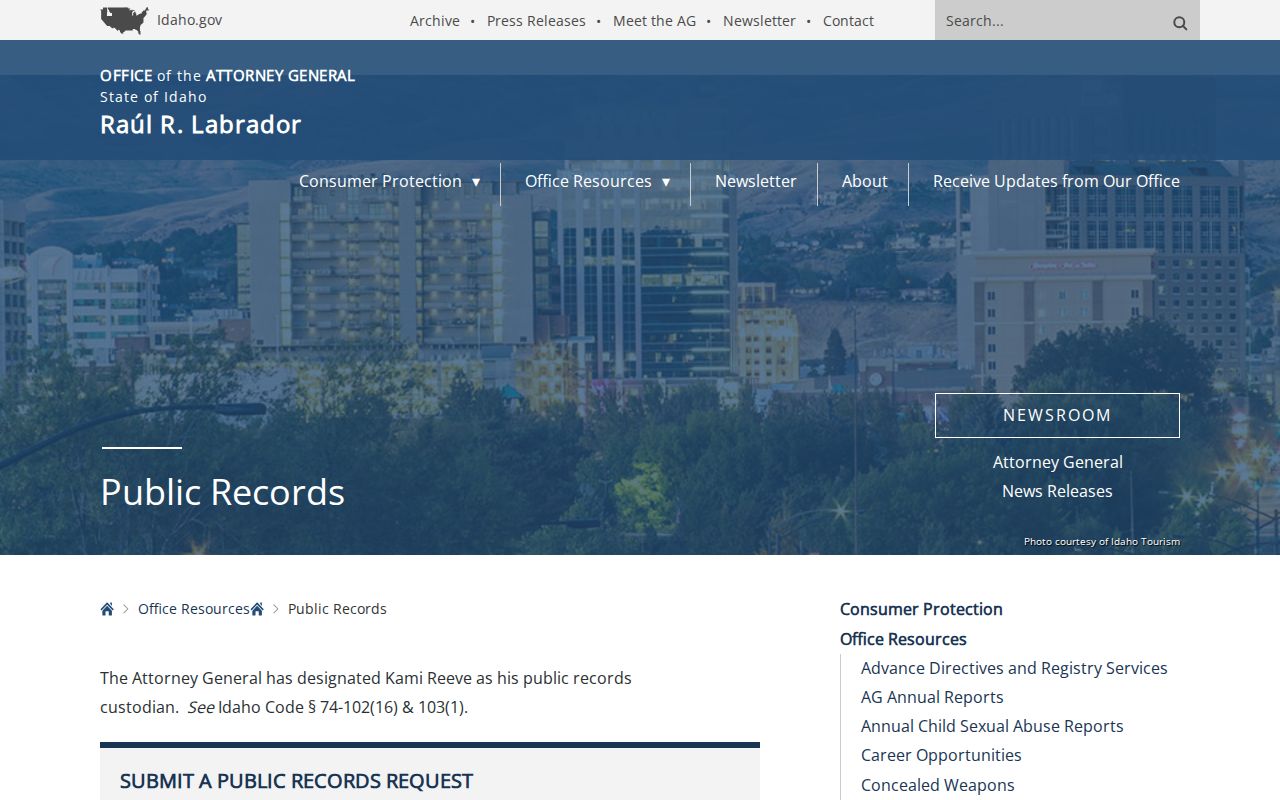
Go to the agency holding the source record. Read its written response for any exemption or cost basis cited.
Idaho Arrest Record and Mugshot Laws
Idaho's public-records law opens many files. It does not open every law-enforcement record. Idaho Code §74-124 sets investigatory limits. The same section names basic arrest and incident facts that fall outside those limits. The basics cover the time, date, place, and nature of an incident. They also cover an arrested person's name, sex, age, and address, plus the arrest time, place, charge, and certain papers. A custodian still applies juvenile protections, court orders, and other exemptions.
Section 20-601 governs county booking. It covers the photo and fingerprint information created for anyone taken to jail. It never orders sheriffs to post every image, keep a photo archive, or delete copies after release. Idaho has no enacted pay-to-remove ban or statewide right to demand deletion from every publisher. That 2022 House Bill 620 proposal was narrow. It never became current law.
The official text of Idaho Code §74-124 lists the investigatory exceptions. It also frames the basic-information rules.
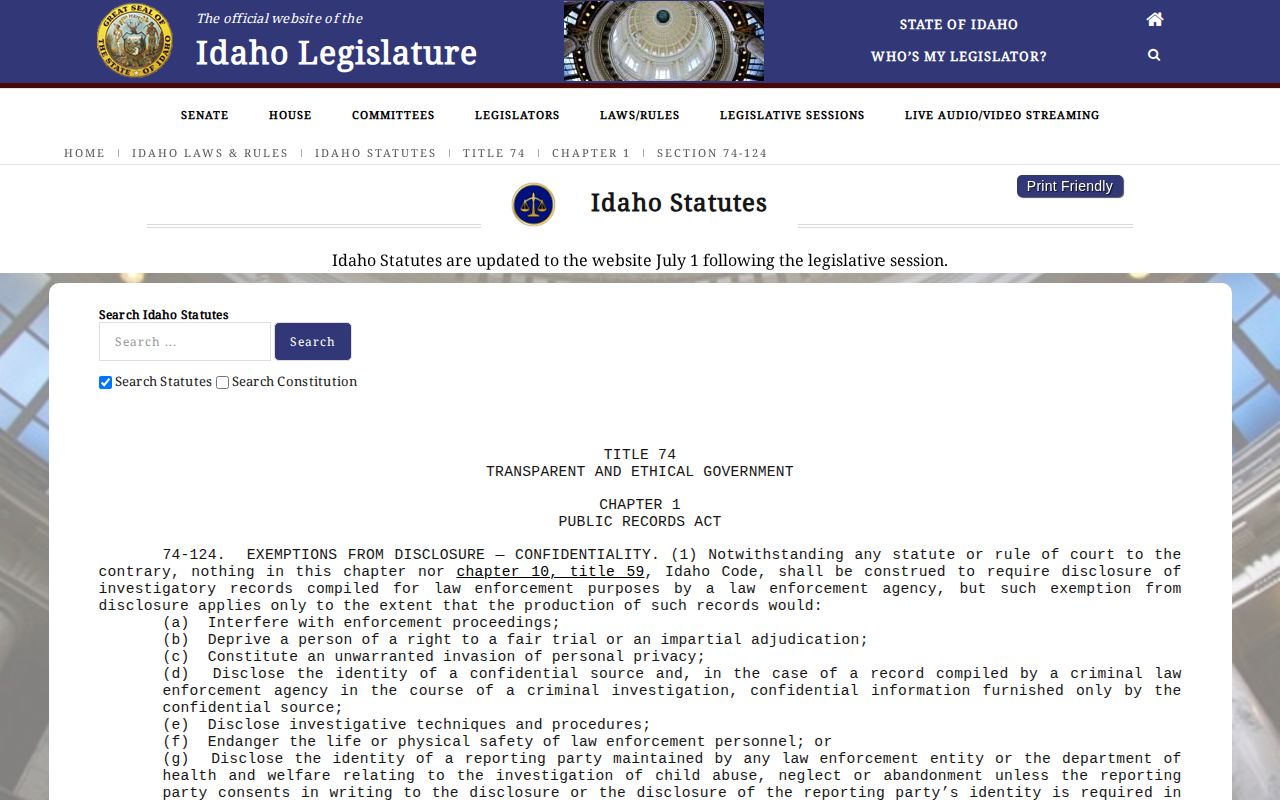
Access turns on three things. The record matters, the custodian matters, and so do the facts behind an exemption.
In a 2026 dispute, the Idaho Statesman covered Ada County's image-publication practices and a third party's claim. That case settled nothing statewide. No ruling created a removal right. Idaho v. Alwin is different too. It concerns a booking photo used in a criminal case, not a commercial site's duty to delete one. Keep those lines clear when someone cites a mugshot law.
Juvenile records follow separate rules for confidentiality and expungement. Idaho Code §74-105 and the juvenile rules can bar disclosure even where adult arrest facts stay public. A young person missing from an adult roster proves nothing. Under the Juvenile Corrections Act, court rules, or an order, a custodian may withhold or redact protected details.
Idaho Arrests, Courts, and Custody
A booking shows an arrest and the charge entered at that stage. It is a jail record, not a court result. For the court side, Idaho runs a iCourt portal statewide. Look there for a filed case, hearing, docket, or public document. Searches work by party, case, or record number. Some cases never get filed at all. Others sit sealed, exempt, or in a legacy system. A hit answers a case question only, not whether someone is in custody right now.
Timing matters too. A county feed can show a fresh booking hours before any prosecutor files anything. After release, the name drops off the current roster. The booking stays in the agency file. Once a sentence moves someone to state jurisdiction, switch tools. The Idaho Department of Correction search covers prison, probation, and parole status. Its database refreshes daily. Its public results list no photo field, and it is not a county booking service.
Federal custody works on its own track. The Federal Bureau of Prisons locator tracks people in BOP custody. It has no booking-photo field either. Marshals post fugitive news, not a full Idaho jail roster. ICE runs a separate immigration locator. No single source spans county, state, federal, and immigration detention.
Charges can also change after booking. A prosecutor may amend or dismiss, and the court disposition is where the outcome lives.
Idaho Record Sealing and Copies
Idaho law gives some arrested people a path to seal the record. Under Idaho Code §67-3004(10), the ISP Bureau of Criminal Identification accepts written requests in three situations. No indictment or information was filed within a year. The person was acquitted on all counts. Or every charge was dismissed, subject to the statute's limits. The request must name the arrest and attach the court or agency paperwork. Watch the wording, though. A dismissal tied to a withheld judgment under §19-2604(1) is treated differently. That means "dismissed," "withheld," "sealed," and "expunged" are not the same status.
Idaho's Clean Slate process can shield eligible records from public view. It requires at least five years after the sentence wraps up. That waiting period counts probation, parole, fines, and restitution. Shielding is not destruction. ISP's rule covers the state repository. A county booking entry, news story, search cache, or private copy may still show the old data. Each custodian needs its own update request, ideally with a final order attached.
Private publishers set their own correction paths. RecentlyBooked says removal, suppression, and modification requests cost nothing and lists what documents to send. Mugshots.com describes a no-charge maintenance route for qualifying matters. BustedNewspaper posts a request form with no fee listed. Arrests.org exposes a removal link too, though no general Idaho fee-free policy is stated. These terms belong to each publisher, not to Idaho law. None of them promises removal.
Start official fixes with the government custodian. The Idaho Attorney General Public Records Law Manual explains one limit. A records request reaches only documents an agency already holds. So skip any middleman demanding payment for a promised result.
For the shield petition itself, the Idaho courts' Clean Slate instructions walk through the filing process.
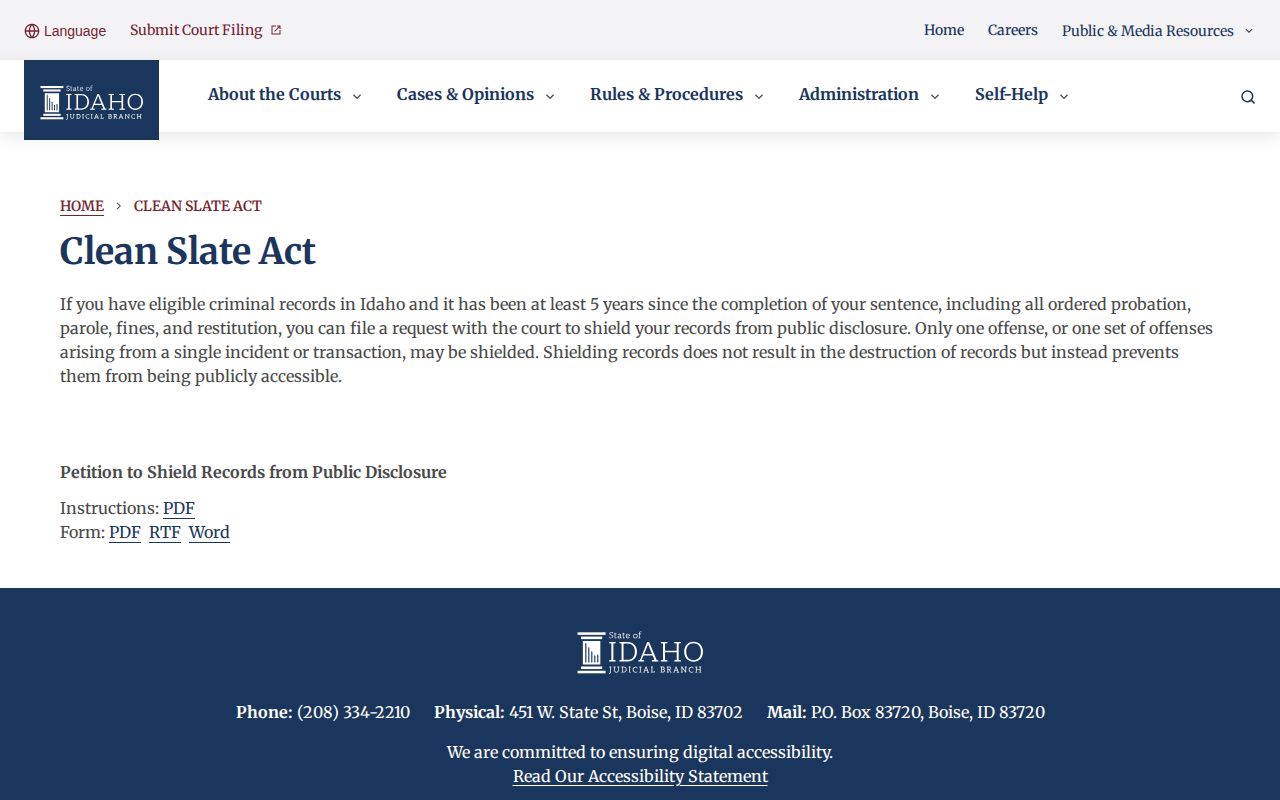
A court order changes access to the official record. Copies held elsewhere do not vanish automatically, so each one needs its own request.
Idaho Arrest Data and Archives
Two statewide tools shape Idaho arrest research, and each answers a different question. The Idaho State Police publish an aggregate arrest-distribution report inside the Crime in Idaho system. It counts arrests in groups. That is its job. It shows trends across a reporting period. It does not show names. It will not tell you who was booked today in any county. For a photo list or a single booking event, ask the custodian. The county or court level holds the real record. Statistics describe the forest. The custodian describes the tree.
History lives elsewhere. The Idaho State Archives keeps government records transferred from state, county, and city agencies under retention rules. Its penitentiary collections stretch across the years from 1864 to 1947. They can hold photographs and case files for historic residents. Treat those files as history, not as a booking feed. The Archives' searchable catalogs work as discovery tools. Plenty of material there has never been cataloged at all. A catalog hit is a lead toward a historic record. It proves nothing about current custody.
The Idaho State Archives searchable indexes describe the historic penitentiary inmate catalog in detail. That is the right starting place for old-case hunting.
Retention rules have their own guide. A law-enforcement records schedule lists booking series, mug-shot series, sealed-record files, dispatch logs, and request files. It dates to 2008 and serves records managers, not the public browsing for jail photos. Some homicide and felony booking records, plus certain indices, get permanent treatment under that schedule. Certain misdemeanor and juvenile series carry stated destruction periods after administrative closure. A court order or a newer agency schedule can still change what survives for any specific file.
When a web page vanishes, go back to the agency. Ask whether the record still exists. Ask which schedule governs it and whether anything moved to the State Archives. An Archives inquiry should name the person and the county or institution. Include the date range too. Name the type of record wanted. The Archives separates a casual research request from a formal public-records request. Reproducing a historic image can mean separate fees and slow processing. Do not confuse that with asking a jail for a current booking photo.
Idaho recent arrests check out best through the custodian of the actual record. A roster shows custody. A court file shows the case, and an archive shows what was retained. Those three views rarely match an old news report, so hold them apart when you compare sources.
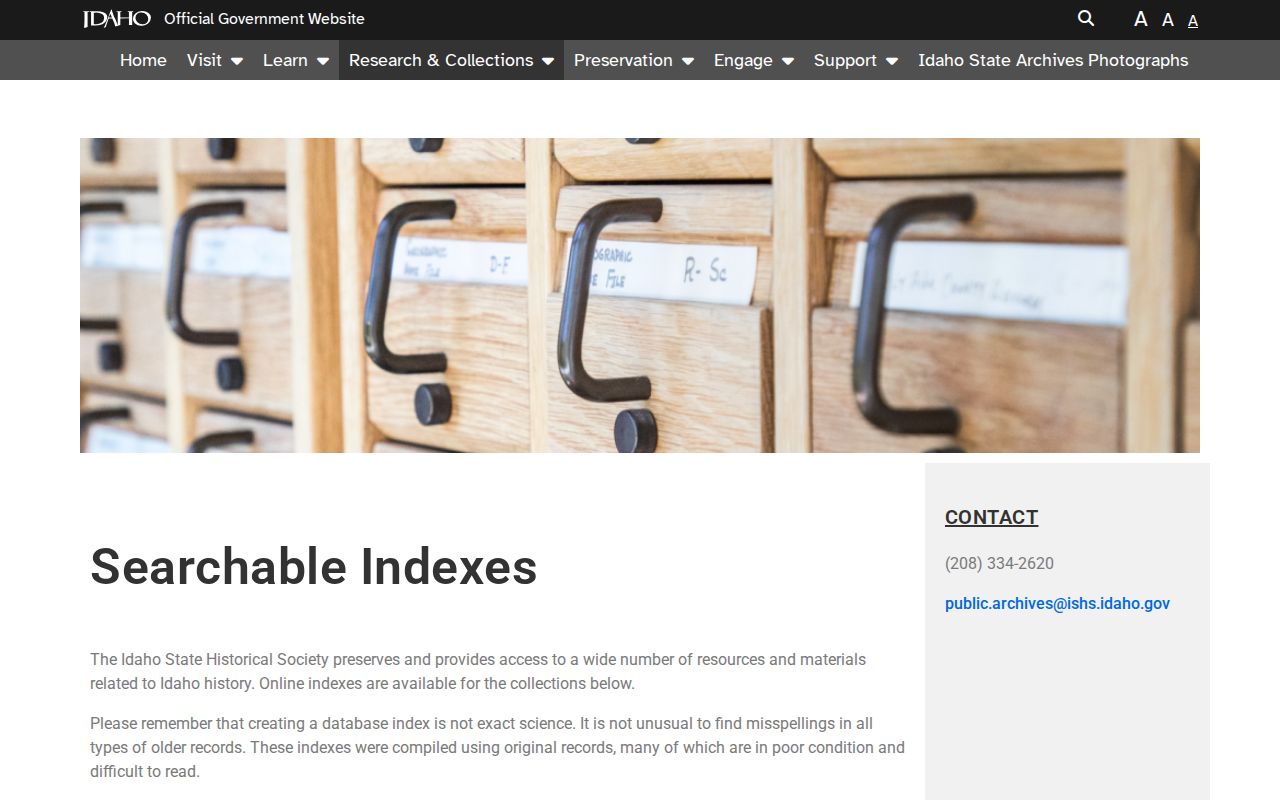
A historic index entry can lead you to retained state material. It cannot answer a present-day Idaho arrest or jail-custody question.