
Idaho VINE Covers Jail Custody
Idaho runs its victim notification network under the name VINE, short for Statewide Automated Victim Information and Notification. The Idaho Sheriffs' Association explains the setup. Appriss partners with county jail booking systems and the Idaho Department of Correction to push notices about incarceration and release events to registered users. That makes VINE a status check. It flags a connected custody record that can trigger an alert. It will not show a final charge. Some forms of custody may go unrepresented too.
The Idaho Supreme Court notification sheet describes the phone and online service and notes that registration is free and anonymous. It flags a reported release or transfer. Still, it is not a full report. It is not a court disposition either, and the source may lag behind a person's actual status.
The Idaho Sheriffs' Association VINE page lays out the statewide service. That page shows service information only.
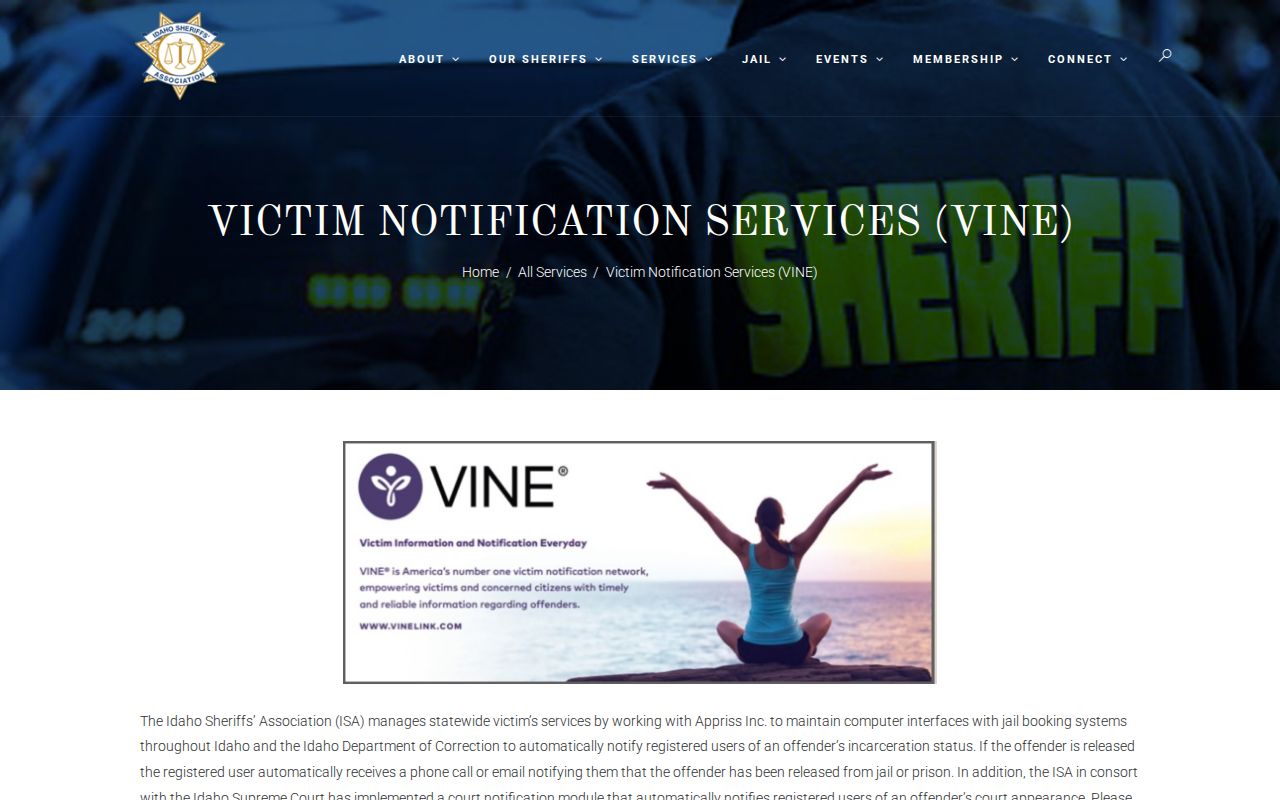
Check one name or sign up for an alert. Treat any notice as a lead, and verify with the source agency whenever timing matters.
All But One Jail, Unnamed
Idaho's Supreme Court notification sheet says the jail feed reaches every county jail in the state but one, plus IDOC. The exception is never named. No statewide public list identifies it. A failed search or outage proves nothing. County-level VINE routes do appear on local government pages and jail interfaces. Those local links can confirm the right county portal. They still cannot name the one exception. A county page may point to VINELink or describe the service. Some also connect a local roster to a separate alert option.
| Coverage evidence | What can be said | How to verify |
|---|---|---|
| Idaho Supreme Court sheet | VINE receives data from all but one county jail, and the exception is not identified. | Search the live Idaho service, then contact the county jail if no record appears. |
| County-local VINE pages | Many county systems link to VINELink or describe their local route. | Use the specific county's official jail or sheriff page. |
| IDOC Victim Services | State correctional custody alerts are described separately from county bookings. | Check current IDOC victim service instructions and the person's state record. |
| Federal custody | BOP, U.S. Marshals, and ICE records are outside Idaho's county jail feed. | Use the relevant federal locator or agency source. |
The unnamed gap reflects a limit in the public participation map, not proof that a specific county skips VINE. Search the live service for that county first. Ask the local jail directly when it matters. Note: The public source does not identify the outlier, so a no-result alone cannot establish a county's participation.
How to Search VINELink Idaho
Start with the direct Idaho VINELink person search, or go through VINELink's home page if the state route has changed. Pick Idaho, then a county, agency, or state category. Search by name or an identifier. Any result comes from a participating system as a custody status record.
- Choose Idaho. Open the Idaho person search and select the county, agency, or state option that fits the arrest or custody record.
- Enter a name or known identifier. Use the spelling shown on the record when possible. If there is a booking or case number, search with it when the form allows.
- Compare more than the name. If several people match, use birth year or date of birth when shown, agency or facility, location, custody status, and case or booking number to tell records apart.
- Open the matching record. Review the status and source location, then use the available registration option if a notice is needed.
Results depend on the connected source. Misspellings and common names change what appears. A recent booking, a transfer, a protected record, or a local system delay can change what appears as well. A name-only match is not enough when several people share the name. Compare the supplied details carefully. Confirm with the jail or agency if anything is unclear. The Idaho VINELink custody search page shows its interface while loading. It is not a completed person record. It is not proof that anyone is in custody.

A blank interface is not the end. Return through VINELink's home page or contact the county agency that may hold the record.
Fields in a VINELink Result
A result view may list a custody status, reporting agency or facility, location label, and a case or booking identifier. Exact fields vary by source and interface. Birth year or date of birth separates similar names. That detail matters with common names. Even so, a record may lack details the jail's own roster or records unit can provide.
| Result detail | How to read it |
|---|---|
| Name and birth detail | Use any birth year or date of birth shown to distinguish people with similar names. |
| Custody status | Shows the status reported by the source system at the time of its update. |
| Agency or facility | Identifies the reporting agency or location label when supplied by that system. |
| Case or booking identifier | Helps connect the result to a specific record; it is not a court outcome. |
| Alert choices | Shows which notice methods are available for the selected record. |
VINE is not a public booking-photo archive. Treat the Idaho result view as a status tool, not a source for mugshots or a complete incident report. Nor is it the final court disposition. A disposition is the court's recorded outcome, so ask the agency holding the booking or court record for those materials.
Note: A VINELink result may omit fields that appear in the jail's own roster or records file.
Register for VINE Alerts
Open the correct person or custody record first. Then choose a phone, text, or email alert option. Idaho's Supreme Court sheet says registration is free and anonymous. Keep your contact method current, and follow the prompt for the four-digit PIN when registering a phone; the PIN confirms receipt of a phone alert.
- Select the event and contact method. Choose the release, transfer, or other status notices offered for that record, then enter a phone number or email address.
- Set and keep the PIN. Enter the four-digit PIN when prompted by a call. Use the same code to confirm a notice if the service requests it.
- Register each needed record. A notice is tied to the selected custody record or court case, not a statewide subscription to every arrest.
- Update contact details. A phone number or email that no longer works can keep a notice from reaching the intended person.
The IDOC Victim Services program handles custody alerts for state prisoners. Its alert menu is broader than most. Notifications can cover full-term release, escape, and death. Alerts arrive by phone, text, or email. A four-digit PIN confirms you got the message. Miss the call, and it repeats every two hours for up to 48 hours until that PIN is entered. TTY access is also part of the setup. Keep in mind these timing rules belong to the IDOC alert program, and a county jail may run its own alerts differently.
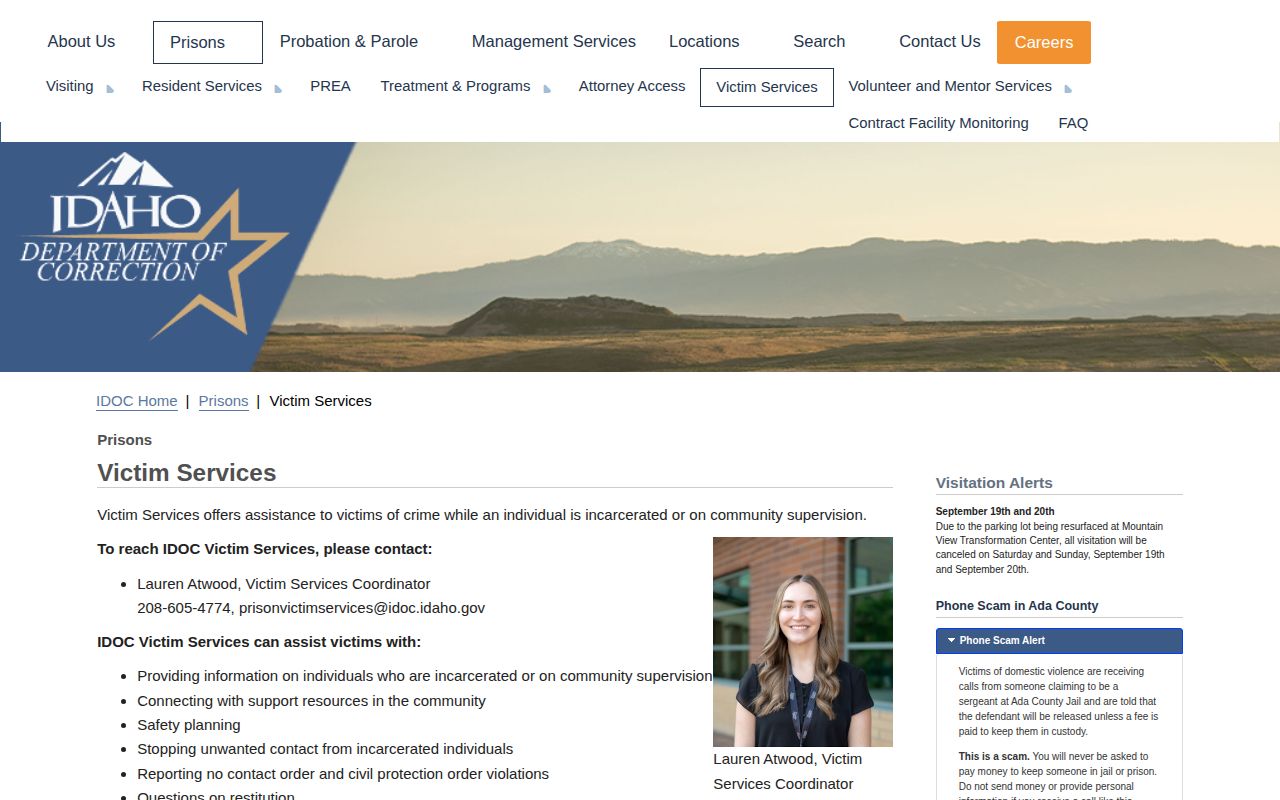
For state custody alerts, follow the current IDOC instructions. Keep your PIN handy for the confirmation call.
Idaho Court Notices Are Per Case
Court notices in Idaho work per case. The Supreme Court information sheet is clear. You must register under each case number that matters to you. One registration covers just one case. It will not sweep in other cases tied to the same person. It also does not replace court records. The court notification sheet lists VINELink and the toll-free VINE line as access routes. The number is 1-866-9VINE-ID (1-866-984-6343). Use the court module for the hearing notices it supports. Use the jail or correctional route for custody changes. Same person, two separate record systems.
IDOC's Resident/Client Search sits further downstream. It holds people under IDOC jurisdiction, whether incarcerated, on probation, or on parole. Updates land around 4 a.m. daily, which makes it a state record rather than a same-day county arrest source. IDOC's VINE restoration notice says service came back on March 6, 2024. Where older pages conflict, the current Victim Services page leads.
Note: A custody alert and a hearing notice may concern one person but rely on separate registrations.
When a VINELink Result Is Missing
A missing VINE result does not tell you much on its own. The system covers participating Idaho county jails plus IDOC. Nothing more. Federal custody runs on separate tracks. It is kept by the Federal Bureau of Prisons, the U.S. Marshals Service, and ICE. The BOP inmate locator is a standalone search with no public booking-photo field. U.S. Marshals Service District of Idaho releases and the ICE Online Detainee Locator cover federal channels, not county jail custody. Fresh arrests lag too. A booking from an hour ago may not appear yet. The Supreme Court sheet mentions 15-minute data collection, but that was a source-era explanation and no promise for every county or event. Someone cited and released may never enter jail. City custody, federal custody, a protected record, a connection issue, or a misspelled name can also block a match.
So treat a no-result carefully. It does not prove there was no arrest, warrant, court case, or custody. Check the county's newest-bookings page or call its records unit. Ask the arresting agency which jail took the person. The Idaho same-day arrest overview explains how county posting windows vary. The County Directory routes you to county sources. The official Idaho iCourt portal can locate a court case. It will not confirm current jail custody, though. For a specific recent booking, the county feed and its records custodian are the strongest fallback. Is it a state sentence? Check IDOC. For federal custody, the federal agency's separate locator is the right tool. A VINE registration can notify you of a reported change. It cannot make an incomplete source record complete.